
SLU-PP-332 vs. SLU-PP-915: What the "Exercise Pill" Research Actually Shows
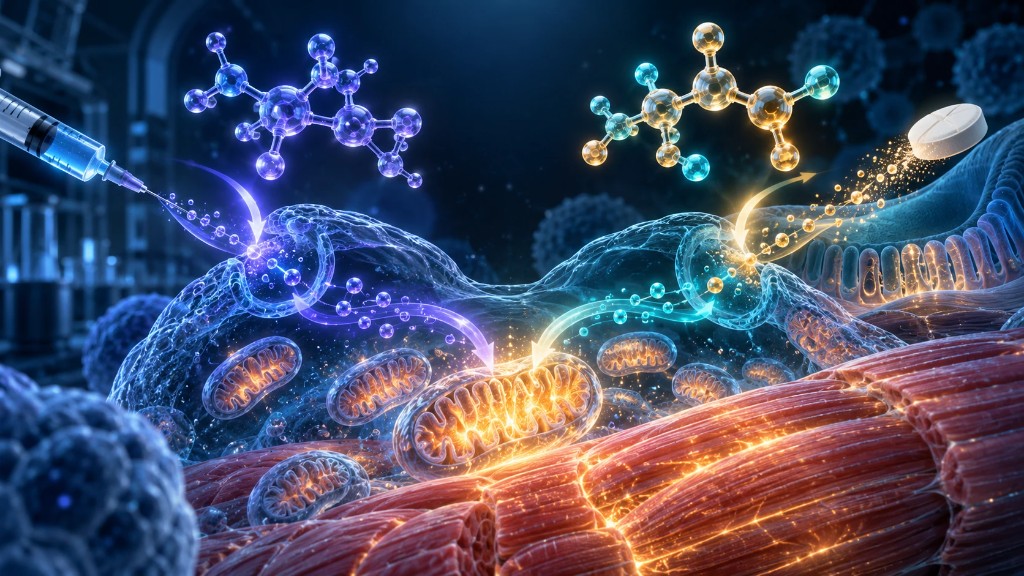
SLU-PP-332 and SLU-PP-915 flip the same biological switch, but 915 was built to do something 332 can't: work when swallowed. That one difference, oral bioavailability, is why researchers now treat 915 as the more practical molecule.
If you've spent any time around longevity or metabolic-health circles, you've heard the pitch: a compound that tricks your muscles into thinking you just went for a run. It's called an "exercise mimetic," and two lab codes keep coming up. Both came out of the same research group, led by pharmacologist Thomas Burris and colleagues at Washington University in St. Louis and Saint Louis University (the "SLU" in the name). Here is what each one is, what the published studies actually show, and why the newer one matters.
The switch both compounds flip
Both molecules turn on a family of proteins called estrogen-related receptors, or ERRs. Despite the name, they have nothing to do with estrogen as a hormone; the name comes from a family resemblance in their structure.
Think of ERRs as the foreman on a factory floor inside your muscle and heart cells. When you exercise, the foreman gets the call and tells the cell to build more mitochondria (the cell's power plants), burn more fat for fuel, and get better at using oxygen. There are three versions of this foreman, called ERR-alpha, ERR-beta, and ERR-gamma. Both SLU compounds are "pan-agonists," meaning they wake up all three.
The idea is simple: if you can wake the foreman without the workout, you might get some of the metabolic benefits of exercise in people who can't exercise, such as the elderly, the injured, or patients with heart failure or muscle-wasting disease.
SLU-PP-332: the original "exercise pill"
SLU-PP-332 is the compound that made headlines, and the mouse data behind it are genuinely striking. It hits all three ERRs but is strongest at ERR-alpha, the version most tied to endurance.
- Endurance (2023). In the paper that introduced it, mice given 332 developed more fatigue-resistant "type IIa" muscle fibers and ran longer before tiring. The drug switched on a gene program that looks like the one triggered by an acute bout of aerobic exercise (Billon et al., ACS Chemical Biology, 2023).
- Weight and blood sugar (2024). In obese mice, 332 raised daily energy burn and fat burning, cut fat mass, and improved insulin sensitivity (Billon et al., J Pharmacol Exp Ther, 2024).
- Aging kidneys (2023). Old mice (21 months, roughly a 60-to-70-year-old human) treated for 8 weeks showed reversal of age-related kidney damage, mitochondrial decline, and inflammation, similar to what calorie restriction does (Wang et al., American Journal of Pathology, 2023).
- Human muscle cells (2025). In muscle cells taken from sedentary older women, 332 lowered oxidative stress and markers of cell aging and helped the cells mature into muscle fibers. This was in a dish, not in people (Bonanni et al., Frontiers in Physiology, 2025).
There's a catch hiding in every one of those animal studies: the mice got 332 by injection into the belly, not by mouth. That detail turns out to matter a lot.
SLU-PP-915: a different key for the same lock
SLU-PP-915 is not a tweaked copy of 332. It's a chemically distinct molecule, built on a different backbone that includes a boron-containing group, designed from a crystal structure of the ERR-gamma receptor. It activates ERR-alpha and ERR-gamma about equally (around 450 nanomolar each in lab assays) and ERR-beta more weakly.
- Heart failure (2023). The two compounds were tested side by side in mice with surgically induced heart failure. Both improved the heart's pumping strength, reduced scarring, and improved survival. 915 improved pumping function starting at week 2, versus weeks 4 to 6 for 332, and it also improved stroke volume and cardiac output, which 332 did not. Both were injected in this study (Xu et al., Circulation, 2023).
- Endurance, taken by mouth (2025). This is the key paper. The same St. Louis group states plainly that 332 "lacks oral bioavailability," then shows that 915 is orally bioavailable. Injected, 915 boosted running distance and duration about as much as injected 332. Taken by mouth, it kept that effect once the dose was adjusted for how much reached the bloodstream. It also stacked with real exercise training, pushing endurance genes and mitochondrial genes higher than training alone (Billon et al., J Pharmacol Exp Ther, 2025). The authors describe 915 as the first ERR agonist shown to work when given orally.
Why bioavailability is the whole ballgame
Bioavailability is the share of a dose that actually reaches your bloodstream in working form. A compound can be brilliant in a test tube and useless in a capsule if your body throws it away before it arrives.
Picture a package shipped across the country. An injection is hand delivery straight to the door. A pill has to survive the stomach's acid, get absorbed through the gut wall, and then pass through the liver, which acts like a customs checkpoint that breaks down and tags foreign chemicals for disposal. Plenty of drugs never make it through customs in meaningful amounts.
That's the core difference here. The researchers who made 332 say it doesn't survive the trip by mouth; every positive 332 animal study used injection. 915 was engineered to survive it. Two practical consequences follow:
- Oral 332 products are resting on injection data. Many 332 products are sold as capsules. The published benefits came from injected doses, and the developers themselves describe 332 as not orally bioavailable.
- 915 is the one you could realistically turn into a pill. For any compound meant for long-term daily use, such as a metabolic, heart, or muscle-wasting therapy, a pill is the format that matters. That's why the developers call 915 a tool for exploring the chronic therapeutic potential of ERR activation.
There's also an early hint about why the two behave differently. A 2026 anti-doping lab study incubated both compounds with human liver enzymes. 332 was broken down into nine byproducts, including three "tagged for disposal" conjugates; 915 produced seven byproducts and none of those tagged conjugates (Möller et al., Rapid Communications in Mass Spectrometry, 2026). That is a test-tube finding, not proof of how either compound behaves in a person, but it fits the picture.
| SLU-PP-332 | SLU-PP-915 | |
|---|---|---|
| First published | 2023 | 2023 (heart study); oral data 2025 |
| Receptor profile | All three ERRs, strongest at alpha | Alpha and gamma about equal, beta weaker |
| Works by mouth (mice) | No, per its developers | Yes |
| How positive animal studies dosed it | Injection | Injection and oral |
| Endurance boost in mice | Yes | Yes, similar to 332 |
| Heart-failure benefit in mice | Yes, from weeks 4–6 | Yes, from week 2 |
| Human trials | None | None |
What the research does not show
Neither compound has been tested in a single human clinical trial. Every result above comes from mice or cells in a dish, and a 2026 systematic review of the field concludes that human trials are still needed to establish whether either is safe or effective in people (de Souza-Lima et al., Revista Médica de Chile, 2026).
A few more things worth knowing before anyone gets excited:
- Mouse bioavailability isn't human bioavailability. 915 absorbing well in mice is a strong signal, not a guarantee for people. No human absorption data exist for either compound.
- Neither is an approved drug. Both are research chemicals. They are not FDA-approved for any use, and products sold online are unregulated, so purity and dose are unverified.
- Long-term safety is unknown. The studies ran weeks, not years. The heart-failure study noted no obvious toxicity at the doses used, but its own authors call for more detailed safety work (Xu et al., 2023).
- Athletes, take note. The World Anti-Doping Agency bans exercise mimetics, and anti-doping labs in Los Angeles and Cologne have already published methods to detect both compounds (Avliyakulov et al., Drug Testing and Analysis, 2026; Möller et al., 2026).
The bottom line
332 proved the concept; 915 is the version built to be taken as a pill. In mice, the two deliver similar exercise-like benefits, and 915 looked somewhat stronger in the heart study. But 915's real advantage is practical: its developers say 332 isn't orally bioavailable, and 915 is. For anyone following this space, that makes 915 the compound to watch, with the honest caveat that the story so far is written entirely in mice.
References
All studies retrieved via PubMed.
- Billon C, et al. Synthetic ERRα/β/γ agonist induces an ERRα-dependent acute aerobic exercise response and enhances exercise capacity. ACS Chem Biol. 2023;18(4):756–771. doi:10.1021/acschembio.2c00720
- Billon C, et al. A synthetic ERR agonist alleviates metabolic syndrome. J Pharmacol Exp Ther. 2024;388(2):232–240. doi:10.1124/jpet.123.001733
- Wang XX, et al. Estrogen-related receptor agonism reverses mitochondrial dysfunction and inflammation in the aging kidney. Am J Pathol. 2023;193(12):1969–1987. doi:10.1016/j.ajpath.2023.07.008
- Xu W, et al. Novel pan-ERR agonists ameliorate heart failure through enhancing cardiac fatty acid metabolism and mitochondrial function. Circulation. 2024;149(3):227–250. doi:10.1161/CIRCULATIONAHA.123.066542
- Bonanni R, et al. Targeting ERRs to counteract age-related muscle atrophy associated with physical inactivity: a pilot study. Front Physiol. 2025;16:1616693. doi:10.3389/fphys.2025.1616693
- Billon C, Appourchaux K, Côté I, Burris TP. An orally active estrogen receptor-related receptor agonist, SLU-PP-915, enhances aerobic exercise capacity. J Pharmacol Exp Ther. 2025;393(1):103787. doi:10.1016/j.jpet.2025.103787
- Möller T, Krug O, Thevis M. In vitro metabolism and analytical characterization of SLU-PP-332 and SLU-PP-915. Rapid Commun Mass Spectrom. 2026;40(8):e70039. doi:10.1002/rcm.70039
- Avliyakulov NK, et al. Analysis and identification of in vitro metabolites of exercise mimetic SLU-PP-332 for doping-control purposes. Drug Test Anal. 2026;18(3):439–450. doi:10.1002/dta.70035
- de Souza-Lima J, et al. Pharmacological activation of ERRα/β/γ as an exercise mimetic: potential therapeutic applications. Rev Med Chil. 2026;154(2):237–245. doi:10.4067/s0034-98872026000200237
This article summarizes published preclinical research for educational purposes. It is not medical advice. Products sold by GL Peptides are intended for laboratory research use only and are not for human consumption.